Emotions in the change process
Here we give a few insights into how change processes are lived and animated by people – with all their emotions, feelings and needs.
The first step is about the emotional processes and a look at how people tick.
The second step is about the social aspect, i.e. the impact on relationship building. All this serves as supporting background knowledge that should help to understand and assess the dynamics in the partners’ or project participants’ processes. In addition, it is important to look at oneself and increase one’s own awareness in dealing with emotions, feelings and needs.
Changes evoke emotions
Changes cause us humans to have to step out of familiar routines that we had sensibly developed in order to save energy. We are challenged to get out of the “autopilot” state, to reorient and sort ourselves out, and then we have the impression that we are no longer as efficient and good as before.
This triggers emotions in most people – often negative feelings like displeasure, dissatisfaction or even fear – but for some also positive ones like joy at something new. In the following, we would like to explain in more detail how this happens inside us.
The emotional processes (emotions and feelings)
The terms emotion and feeling are used differently in the literature, often synonymously. However, we distinguish them because it is helpful for working with people.
Emotion means the “moving and mobilising effects of affective forces” (Ciompi 1997, p.95) and is usually used as a generic term. Feeling, on the other hand, is the linguistic designation of emotions (Scheler 1999, p.45).
Because the linguistic naming of our bodily experience is a challenge for many, the path of exploring bodily reactions is easier. We feel hot or cold, something contracts or relaxes. Only when we become aware of this we can express it as a feeling.
What exactly happens in us humans in relation to emotions and feelings?
We would like to illustrate this with the following diagram:
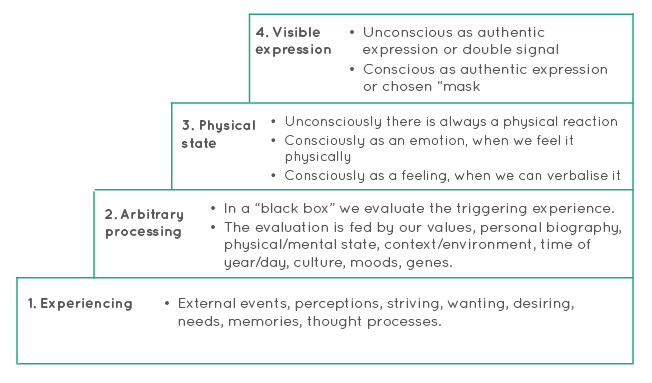
Source: School of Facilitating
How is the graphic to be understood?
First: triggering experience
A triggering experience is caused either externally by something we perceive with our senses, or internally by our thoughts or memories. Both end up automatically in our black box.
Second: inner involuntary processing
Our biographies are stored in the black box in the form of our emotional experience memory and unconsciously stored life experience.
Innate affects, impulses and drives are also at work here. This is where the “private” person is located, although it has an equal effect on the world of work or engagement. We cannot look into the black box. Surprises, sensitivities or even outbursts arise from it again and again, which can only be explained at second glance, as long as the person in front of us manages to open the black box a little. Knowing about the black box helps to better understand the complexity of people and to deal with it openly and respectfully.
Thirdly: physical state
A physical state arises whether or not we have conscious access to our bodily reactions. This is where emotional intelligence comes in: if we are in tune with our body reactions caused by emotions and can name them as feelings, we can understand them as signals. They help us make conscious decisions and navigate our way through life.
Fourth: visible expression
Emotions control our decisions, they influence our motivations, thoughts, memories and actions, they arise in the unconsciously working system of the brain. Emotions can show up consciously as a nameable feeling or as more vaguely perceptible impulses.If they remain unconscious, we send the signals of physical reaction in our non-verbal behaviour and in our verbal expressions involuntarily, arbitrarily. If we become aware of them as feelings, we can decide what to bring into communication.
Conclusions for the work of a facilitator
Attributions like “you make me furious” or “you make me happy” do not correspond to our inner processes. These statements are triggered by a feeling that we have not really perceived in ourselves. We feel angry, are not aware of our inner processes and blame the other person.
Let’s remember: the feeling is triggered by an experience, which in turn triggers memories or thoughts inside us, which then consciously or unconsciously run through our evaluation system and lead to bodily reactions. Although we do not necessarily control these processes consciously, it is important to notice feelings about ourselves and to take responsibility for our own feelings. It is primarily a process from the inside out. This is a very important aspect of the work of facilitators: to mirror these distortions to the people we work with so that they can take back responsibility for their feelings and constructions and step out of the self-deception.
Example “Emotional carousel”

In a team workshop, the focus is on how the goals can be achieved together.There are different ideas about how this should be done.
Suddenly A bursts into a rage and says to his colleague B: “You make me angry!”
He is attacking colleague B without realising it because A feels emotionally burdened.
The facilitator intervenes, takes on the role of B and looks for the trigger: “Assuming I am B. What exactly do I have to do to make you angry?” He waits for the answer.
A: “Again and again you insist on your statements and don’t address my points.”
Facilitator: “How does it happen that this is exactly what triggers anger in you? What is happening to you?”
Then the facilitator helps to put A’s statement into an appropriate cause-effect context: “When I see you doing X, I get angry because it violates my sense of justice and I feel unfairly treated.”
This helps colleague B to better understand his triggering behaviour and A discovers his own inner connections and can take responsibility for them.
As in the example above, it is often the cause-effect relationships that are not expressed that lead to distorted expression and cause situations to escalate unnecessarily. As facilitators, we make sure that the structure underneath the abbreviated statements becomes clear and is communicated. And we engage in meta-communication by making the participants aware of the dynamics and their effects.
Reflection:
Remember a similar experience in your team or with a partner organisation when a project has been discussed or when you address any topic with family, friends or colleagues. With these insights regarding emotions and the emotion ladder, how would you address future similar situations in a different way? Which competences do you need to reinforce to work with emotions in a productive, constructive and constructive way?